
How to Answer “Tell Me About Yourself” Without Freezing — A 2026 Framework
It is the most predictable, universal, and terrifying question in the modern corporate world. You spend days preparing for a high-stakes technical interview. You review your cloud architecture notes, you memorize your system design frameworks, and you check your webcam lighting. The call connects, the hiring manager smiles, and before they ask a single technical […]
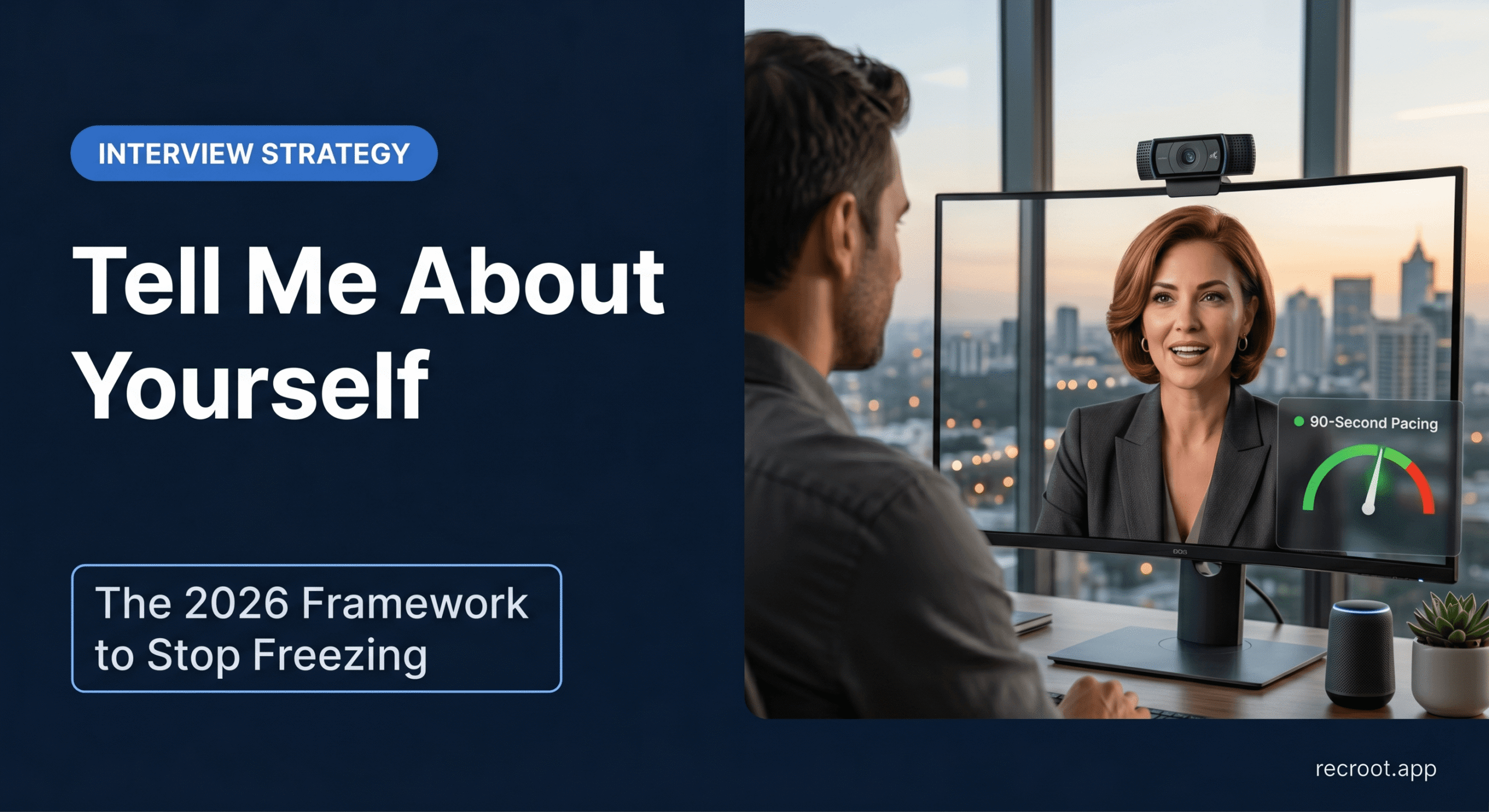
It is the most predictable, universal, and terrifying question in the modern corporate world.
You spend days preparing for a high-stakes technical interview. You review your cloud architecture notes, you memorize your system design frameworks, and you check your webcam lighting. The call connects, the hiring manager smiles, and before they ask a single technical question, they drop the ultimate open-ended prompt:
“So, tell me a little bit about yourself.”
For the introvert at work, or any candidate suffering from interview anxiety, this innocent sentence is a psychological trap. Because there are no boundaries to the question, your brain panics. You suddenly forget where to start. Do they want to know about your childhood? Your college degree? The internship you did three years ago?
Without a structured framework, candidates default to one of two fatal reactions: they either freeze entirely, or they nervously ramble, reciting their PDF resume bullet-by-bullet.
In the hyper-competitive class of 2026 job market, hiring managers do not have the patience for a chronological life story. They have already scanned your profile. This question is not about gathering facts; it is a test of your executive presence, your self-awareness, and your ability to communicate concisely under pressure.
Here is the definitive 2026 framework to answer “Tell me about yourself” with absolute authority, and how to practice it until your anxiety disappears.
The Psychological Trap: Why You Freeze
To fix the freeze, you must understand why it happens.
When humans are faced with an unstructured, open-ended task while under observation (like an interview), the brain’s amygdala triggers a mild “fight or flight” response. For quiet professionals, this floods the system with adrenaline, causing your vocal cords to tighten and your working memory to wipe blank.
You aren’t freezing because you are unqualified. You are freezing because you are trying to synthesize 10 years of life experience into a 90-second summary in real-time.
The cure for this is boundary setting. You must build a rigid mental fence around your answer so your brain doesn’t have to search for what to say next.
The 2026 Framework: Present, Past, Future
The most effective way to build that boundary is the Present-Past-Future (PPF) framework. It keeps your answer strictly under 90 seconds, prevents you from rambling, and perfectly aligns your career trajectory with the company’s immediate needs.
Here is how to structure it for the modern tech landscape.
1. The Present (Who you are right now)
Start with a strong, definitive statement about your current professional identity and your verified skills. Do not start with your graduation year or your hometown. Start with your current value.
- The 2026 Angle: Highlight your integration of modern tools.
- Example: “I am a full-stack developer with a deep focus on building scalable front-end applications. In my current capacity, I specialize in combining React ecosystems with AI-assisted workflow tools to accelerate feature deployment.”
2. The Past (The Proof)
This is where candidates make the biggest mistake. Do not recite your resume. The hiring manager is already looking at it. Instead, highlight one or two “messy” projects or high-impact wins that prove the statement you just made in “The Present.”
- The 2026 Angle: Focus on problem-solving, not just task completion.
- Example: “Before focusing purely on the front-end, I spent two years leading a data migration project for a mid-sized retail brand. It was a highly complex environment, but it taught me how to manage messy databases and communicate technical roadblocks directly to non-technical stakeholders.”
3. The Future (The Alignment)
This is the “hook.” You must smoothly transition your past experience directly into why you are sitting in this specific interview. This proves you did your research and aren’t just blindly applying to hundreds of jobs.
- The 2026 Angle: Tie your goals to their specific product or market challenge.
- Example: “Now that I’m looking for my next challenge, I want to take that architectural experience and apply it to a fast-moving startup. I know your team is currently scaling your mobile user base, and that is exactly the kind of high-impact environment I thrive in. That is why I was so excited to speak with you today.”
The Secret Weapon: Eliminating the “Blind Rehearsal”
Knowing the PPF framework is easy. Delivering it smoothly when your heart rate hits 120 BPM is the hard part.
Most candidates try to cure their interview anxiety by practicing their answer in the bathroom mirror or recording it on their phone. This is a “blind rehearsal.” The mirror cannot tell you if you are speaking too fast, using too many filler words, or lacking confident eye contact.
To build true career confidence, you need objective, data-driven repetition.
This is exactly why candidates are using LEA AI on the Recroot.app. LEA acts as your personal mock interview app. You can log in, select a behavioral interview scenario, and LEA will look at you and say, “Tell me about yourself.”
You deliver your Present-Past-Future script out loud. When you finish, the AI doesn’t just say “Good job.” It analyzes your pacing. It flags your filler words (“um,” “like”). It evaluates the structural flow of your answer.
By practicing this single question with a zero-judgment AI coach ten times before your actual interview, you strip the emotion and the panic out of the delivery. The anxiety disappears, replaced entirely by behavioral muscle memory.
When the real hiring manager asks the question, you won’t freeze. You will just press play.
Executive Summary & Takeaways
- The question “Tell me about yourself” causes interview anxiety because it is unstructured, forcing the brain to panic while trying to summarize a lifetime of experience.
- Never recite your resume chronologically; hiring managers have already read it and are testing your communication skills, not your memory.
- Utilize the Present-Past-Future (PPF) Framework to keep your answer under 90 seconds and highly relevant to the role.
- Highlight your “Present” professional identity, prove it with a “Past” high-impact project, and align your “Future” goals directly with the company’s current needs.
- “Blind rehearsals” in a mirror do not cure anxiety. Use a mock interview app like Recroot.app to practice with LEA AI and receive real-time, data-driven feedback on your pacing and structure.
Frequently Asked Questions (FAQ)
How long should my answer to “Tell me about yourself” be?
Your answer should strictly be between 60 and 90 seconds. Anything shorter feels unenthusiastic and brief; anything longer than two minutes risks boring the interviewer and derailing the schedule.
In 2026, it is best to keep the answer strictly professional unless a personal hobby directly relates to the role or the company culture (e.g., mentioning you run marathons if you are interviewing at a fitness tech startup).
Filler words happen when your brain is trying to load the next sentence but your mouth refuses to stop moving. The cure is the “strategic pause.” Practice stopping completely for a full second between thoughts. You can use LEA AI to track and reduce your filler word count over time.
Your answer should strictly be between 60 and 90 seconds. Anything shorter feels unenthusiastic and brief; anything longer than two minutes risks boring the interviewer and derailing the schedule.
-

How to Present Confidently at Work (Even If Public Speaking Isn’t Your Strength)
A practical guide to improving your presentation skills, communicating with confidence, and delivering effective presentations…
-

How to Lead Meetings at Work: Practical Tips for Managers and Professionals
Learn how to prepare, facilitate, and lead productive meetings that keep discussions focused, decisions clear,…
-

How to Speak Confidently at Work: What I Learnt After Struggling for the First Five Years of My Career
A practical guide to improving workplace communication, speaking up in meetings and building confidence as…
