
The Hidden Job Market in 2026: Stop Applying Online
If your entire job search strategy consists of updating a PDF resume, logging into a major job board, and clicking “Apply Now” 50 times a day, you are playing the hardest possible version of the game. By the time a role is publicly listed on a major job board, you are already late to the […]
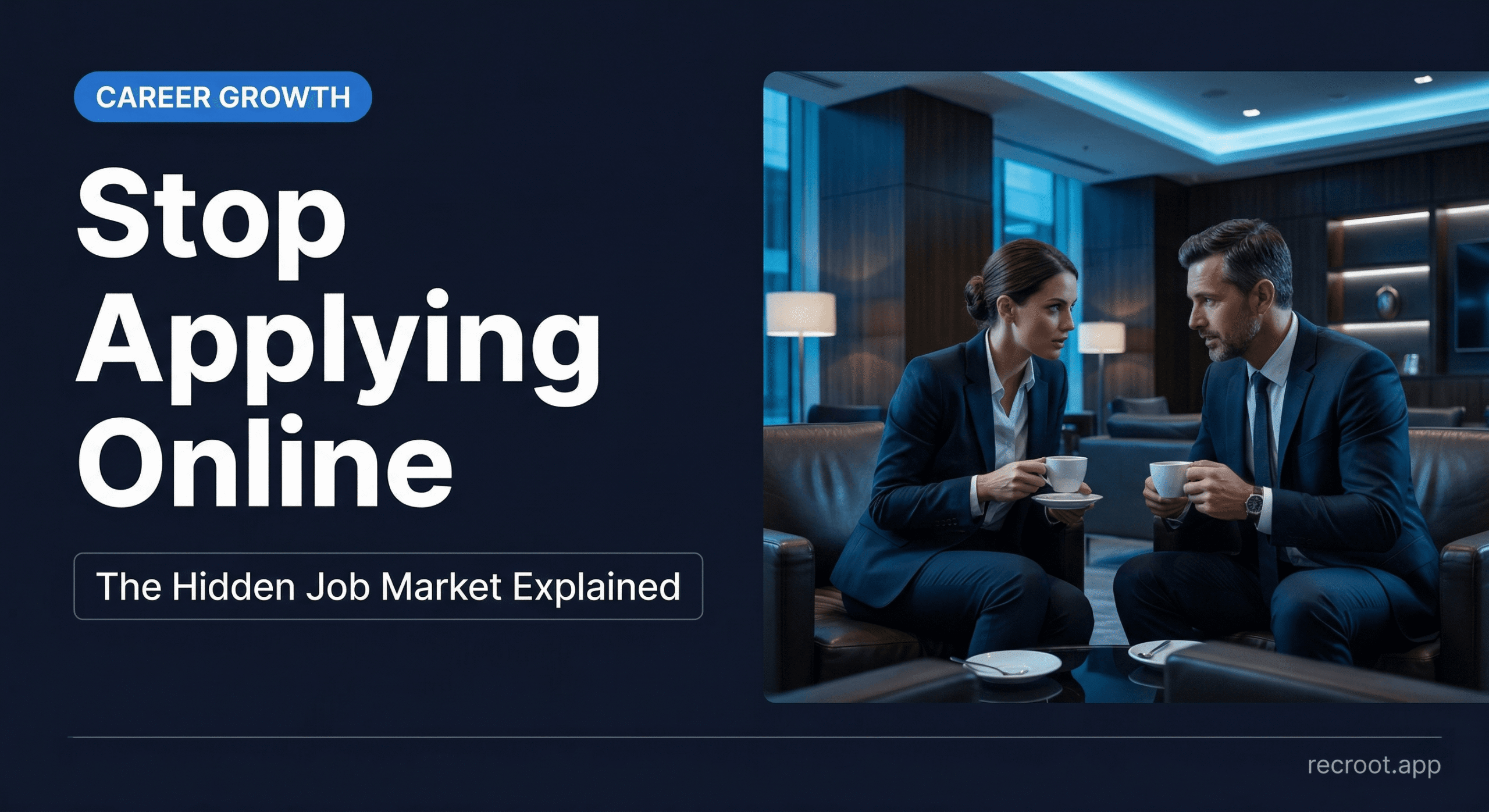
If your entire job search strategy consists of updating a PDF resume, logging into a major job board, and clicking “Apply Now” 50 times a day, you are playing the hardest possible version of the game.
By the time a role is publicly listed on a major job board, you are already late to the party.
The hiring manager has likely already asked their internal team for referrals. They have checked their internal talent pool of past runner-up candidates. Recruiters have already spent a week quietly sourcing passive talent on professional networks.
When you apply online, you are fighting for the leftovers against thousands of other desperate applicants, leaving your fate in the hands of a rigid Applicant Tracking System (ATS).
To actually land high-quality roles in 2026, you have to access the hidden job market.
What Is the Hidden Job Market?
The hidden job market refers to the massive percentage of open jobs (estimated by many career experts to be up to 80%) that are filled through networking, internal mobility, and direct inbound sourcing before they are ever publicly advertised.
Companies do not want to post jobs publicly if they don’t have to. Public postings result in a flood of thousands of unqualified resumes that overwhelm HR departments. A hiring manager would much rather hire a known entity—someone recommended by a trusted colleague or someone whose verified work they have already seen.
Reversing the Funnel: Inbound vs. Outbound
The traditional job search is outbound: You push your resume toward a void and hope someone reads it.
Accessing the hidden job market requires building an inbound strategy: You position your skills and proof of work so that recruiters and hiring managers find you before they officially open the headcount.
The “Information Interview” Bypass
Identify 10 to 15 companies you genuinely want to work for. Find mid-level managers or senior individual contributors on those teams. Send a brief message requesting a 15-minute chat to discuss their career path and industry trends. Do not ask for a job.
When headcount eventually opens up on their team three months later, you are no longer a stranger in an ATS database; you are a professional contact they have already vetted.
Public Proof of Work
Stop hiding your capabilities inside a private, static PDF document. If you are a developer, make your GitHub active. If you are a marketer, publish strategic teardowns. If you are in operations, write about efficiency frameworks.
You must create a living, verified portfolio that signals your workplace readiness to recruiters who are actively hunting for your specific skill set behind the scenes.
The Death of the Static Resume
The traditional resume is a historical document that tells an employer what you did three years ago. It does not prove what you can do today.
To become visible in the hidden job market, you need a dynamic profile. Platforms that verify your actual skills and match them via API directly to the backend systems of employers allow you to bypass the public “Apply Now” button entirely. You enter the hidden job market by becoming exactly what the algorithms are sourcing for.
Key Takeaways
- The vast majority of high-quality jobs are filled before they are ever posted on public job boards.
- Relying solely on the “Apply Now” button pits you against thousands of applicants and strict ATS filters.
- Build an inbound career engine by creating public proof of work that attracts recruiters.
- Use informational interviews to build relationships with teams before they officially open a headcount.
- Shift from a static PDF resume to a dynamic, skill-verified profile to remain visible to active sourcers.
Frequently Asked Questions
Do cold emails to hiring managers actually work?
Yes, but only if they are short, highly personalized, and focus on a specific business problem the manager is facing. Sending a generic “Here is my resume, please hire me” email will be instantly deleted.
How much time should I spend applying online vs. networking?
If you are actively unemployed, shift your ratio to 20% online applications and 80% direct outreach, informational interviewing, and public skill-building.
Isn’t networking just asking people for favors?
No. Bad networking is asking for favors. Good networking is exchanging value. Focus on what you can learn from them or what insights you can share, rather than what they can do for your employment status.
Stop submitting PDFs into the void. Build your dynamic, verified profile on Recroot.app and let the employers in the hidden job market come to you.