
The Cost of a Bad Hire: How AI Vetting Is Saving Companies Millions
Nobody hires badly on purpose. Every wrong hire starts with good intentions — a role that needed to be filled, a candidate who interviewed well, a gut feeling that turned out to be wrong. And then three months later, you’re managing a performance issue, carrying the rest of the team through someone else’s gap, and […]
Nobody hires badly on purpose.
Every wrong hire starts with good intentions — a role that needed to be filled, a candidate who interviewed well, a gut feeling that turned out to be wrong. And then three months later, you’re managing a performance issue, carrying the rest of the team through someone else’s gap, and quietly calculating how long before you can start the process again.
The cost of that mistake is higher than most organisations want to admit.
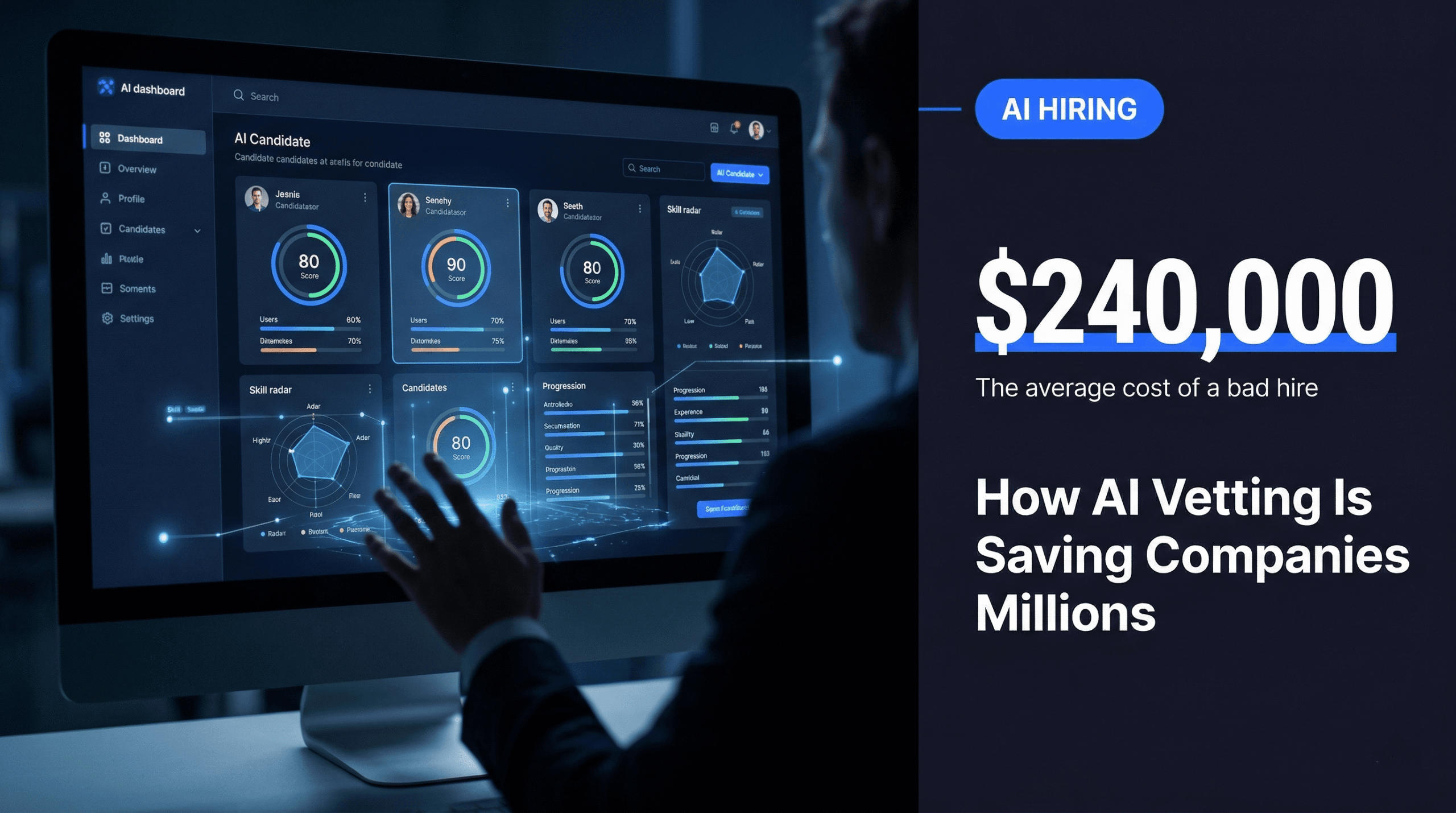
In 2026, estimates from SHRM and the U.S. Department of Labor put the average cost of a bad hire somewhere between $17,000 for an entry-level position and $240,000 or more for a senior or executive role. That range includes recruitment fees, training time, lost productivity, management overhead, and the full cost of replacing them.
And that’s before you count the team morale damage. The projects that slipped. The good people who got frustrated and quietly started looking elsewhere.
Why Bad Hires Happen — The Honest Version
The standard explanation is “we didn’t have enough information.” That’s partly true, but it misses the real issue.
Bad hires happen because the process was optimised for speed, not accuracy.
A role opens. There’s pressure to fill it. Someone interviews on a Tuesday when the hiring manager has four other things going on. The candidate says the right words. Their CV looks reasonable. Nobody wants to extend the process further so a decision gets made.
Two months later, the cracks appear.
The interview was never designed to catch what actually predicts performance. It caught presentation skill, preparation, and the ability to say what an interviewer wants to hear. Those aren’t the same as job competence, work ethic, or cultural alignment.
What the Numbers Actually Look Like
Let’s make this concrete.
For a role at a $60,000 salary, a single bad hire can cost between $30,000 and $120,000 once you factor in separation costs, the productivity gap while the role is vacant, training the wrong person, and then running the full recruitment process again.
The Society for Human Resource Management estimates that replacing a bad hire costs anywhere from 50% to 200% of the employee’s annual salary. For senior hires, that figure climbs significantly higher.
In high-volume hiring environments — where organisations are filling dozens or hundreds of roles — even a modest bad-hire rate compounds into staggering annual costs.
Here’s what makes this particularly frustrating: most of it is preventable.
Where Traditional Screening Falls Apart
The typical hiring process looks something like this: CV review, phone screen, one or two rounds of interviews, offer.
Each of those steps has well-documented failure modes.
CV screening is subjective, inconsistent, and easy to game. Two recruiters reviewing the same CV will assess it differently based on their mood, workload, and unconscious preferences. Candidates who know how to write CVs — not necessarily the best candidates — sail through while others get filtered out.
Phone screens catch basic availability and communication but rarely assess actual fit. First-round interviews often become conversations rather than structured assessments. Final-round interviews introduce more stakeholders and more inconsistency.
The result is a process that measures how well someone can navigate a hiring process — not how well they’ll actually perform in the role.
How AI Changes the Equation
AI doesn’t solve the people problem in hiring. What it does is remove the inconsistency, subjectivity, and time-cost from the early stages — and replace them with structured, data-driven assessment at scale.
Here’s what that looks like in practice.
Instead of a recruiter spending 20 hours screening CVs for a single role, AI processes hundreds of applications against clearly defined criteria in minutes. Every candidate is evaluated against the same standard, not a different one depending on which recruiter is working that day.
Instead of a phone screen where the outcome depends on whether the screener is tired or distracted, an AI interviewer conducts structured calls with every candidate — assessing communication, role fit, and relevant skills consistently across all of them.
The numbers back this up. Companies using AI-driven hiring are reporting up to 30% reductions in cost-per-hire. AI-selected candidates are 14% more likely to succeed at interview and 18% more likely to accept offers. Average time-to-hire has dropped from 34 days to 14 days in some implementations.
For a company filling 50 roles a year, the combined effect is hundreds of thousands of dollars in annual savings — not counting the downstream value of better hires staying longer and performing better.
What Recroot.io Actually Does
This is exactly the problem Recroot.io was built to solve.
When you post a role on Recroot, the platform sources candidates from a pre-screened database of professionals across India and the Philippines. Then LEA — Recroot’s AI interviewer — conducts structured screening calls and assessments with every candidate.
By the time candidates reach your desk, they’ve already been evaluated for communication skills, technical fit, and role alignment. You get a detailed report on each person: scores, strengths, concerns, video review, and an authenticity check to ensure you’re seeing genuine responses.
Your first real conversation with a candidate is no longer a screening conversation. It’s a final-stage discussion with someone who’s already been vetted.
For startups and growing companies where every hire matters and every hour counts, that changes the economics of hiring completely.
The Hidden Cost Nobody Talks About
There’s a dimension of the bad hire problem that doesn’t show up in any cost calculator — what it does to the people around the wrong hire.
High performers notice immediately when someone isn’t pulling their weight. They pick up the slack, quietly. For a while. Then they start to wonder why the organisation hired this person and didn’t notice the problem sooner. Then they start questioning whether management actually knows what they’re doing.
This is how bad hires drive good people out.
The retention cost of keeping a bad hire too long often exceeds the cost of the bad hire itself. When you lose a strong performer because they got tired of compensating for someone who shouldn’t have been hired in the first place — that’s a compounding loss.
Getting the initial hire right isn’t just about that one hire. It’s about the signal it sends to every person already on your team about the standards you hold.
Key Takeaways
- A bad hire costs between $17,000 and $240,000 depending on the role — and most of it is preventable.
- Traditional hiring processes measure how well someone navigates an interview, not how well they’ll perform in the role.
- AI screening removes the inconsistency and subjectivity from early-stage evaluation.
- Companies using AI-driven hiring report up to 30% lower cost-per-hire and significantly faster time-to-fill.
- AI-selected candidates are 14% more likely to succeed at interview.
- The indirect cost of a bad hire — team morale, retention of strong performers — is often higher than the direct cost.
- The goal isn’t just to fill a role. It’s to fill it correctly the first time.
Frequently Asked Questions
What is the average cost of a bad hire in 2026?
Estimates from SHRM and the U.S. Department of Labor put the range at $17,000 for entry-level roles up to $240,000 or more for senior hires. This includes recruitment, training, lost productivity, and replacement costs.
How does AI reduce bad hires specifically?
By replacing subjective human screening with consistent, structured assessment at scale. AI evaluates every candidate against the same criteria, removes decision fatigue, and uses predictive analytics based on what successful hires in similar roles actually look like.
Is AI hiring fair to candidates?
When implemented well, AI can actually be fairer than human screening, which is subject to unconscious bias, inconsistency, and decision fatigue. The key is that assessment criteria are role-relevant, transparently defined, and regularly audited.
Can small companies benefit from AI hiring tools?
Yes — arguably more than large ones. For a 20-person startup, one bad hire in a key role is disproportionately damaging. AI screening lets small teams access the same quality of vetting previously only available to companies with large HR departments.
How quickly can AI hiring tools show ROI?
Most organisations see positive ROI within three to six months. The clearest early wins are reduced time-to-hire, lower screening costs, and a measurable improvement in applicant quality reaching the final interview stage.
Tired of sifting through hundreds of applications to find three people worth interviewing? Recroot.io handles the screening so you don’t have to — delivering pre-vetted candidates with detailed AI assessment reports within 96 hours of posting your role.